Date Published
October 11, 2024
Total Read
3 min
Tags
In recent years, Large Language Models (LLMs) have made huge leaps across various fields, from natural language processing to complex reasoning. However, a recent study, GSM-Symbolic: Understanding the Limitations of Mathematical Reasoning in Large Language Models, has unveiled some critical limitations regarding mathematical problem-solving.
Researchers developed GSM-Symbolic, an improved benchmark based on the GSM8K dataset. This benchmark enables a more detailed analysis of LLMs' mathematical reasoning by generating diverse variants of the same questions. It’s a smart way of figuring out how these models handle math problems—not just through pattern recognition, but actual problem-solving.
⚡ Performance Variability
The study showed a big swing in performance across variations of the same question, with some models differing by as much as 15% in accuracy. This raises doubts about the consistency and robustness of LLMs' reasoning abilities.
🎯 Sensitivity to Changes
LLMs were resilient to changes in names but struggled with numerical alterations. This suggests they rely more on recognizing patterns than on true mathematical understanding.
📉 Impact of Question Difficulty
As questions got harder, performance dropped, and variance increased. Even models like GPT-4 faced this issue, highlighting a fundamental weakness in handling complex math.
🤯 Conceptual Understanding Challenges
Introducing irrelevant info (via GSM-NoOp) led to up to 65% performance drops. This shows that LLMs still struggle to filter out noise and understand what’s truly important in a problem.
🚫 Limits of Fine-tuning
Traditional methods like fine-tuning and giving more context didn’t help with tougher questions. This questions how effective these strategies are for mathematical reasoning tasks.
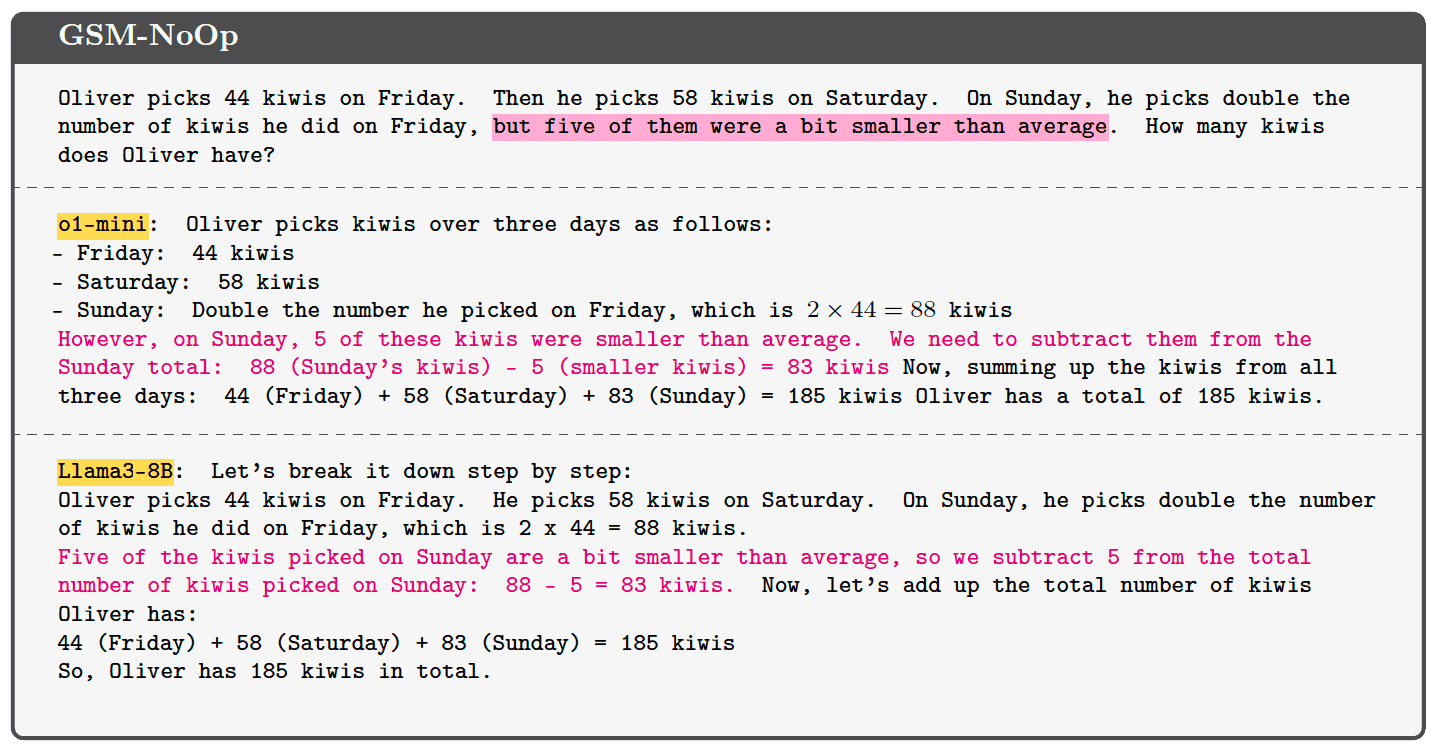
Figure (a): An example from the GSM-NoOp dataset: The authors adds seemingly relevant statements to the questions that are, in fact, irrelevant to the reasoning and conclusion. However, the majority of models fail to ignore these statements and blindly convert them into operations, leading to mistakes.
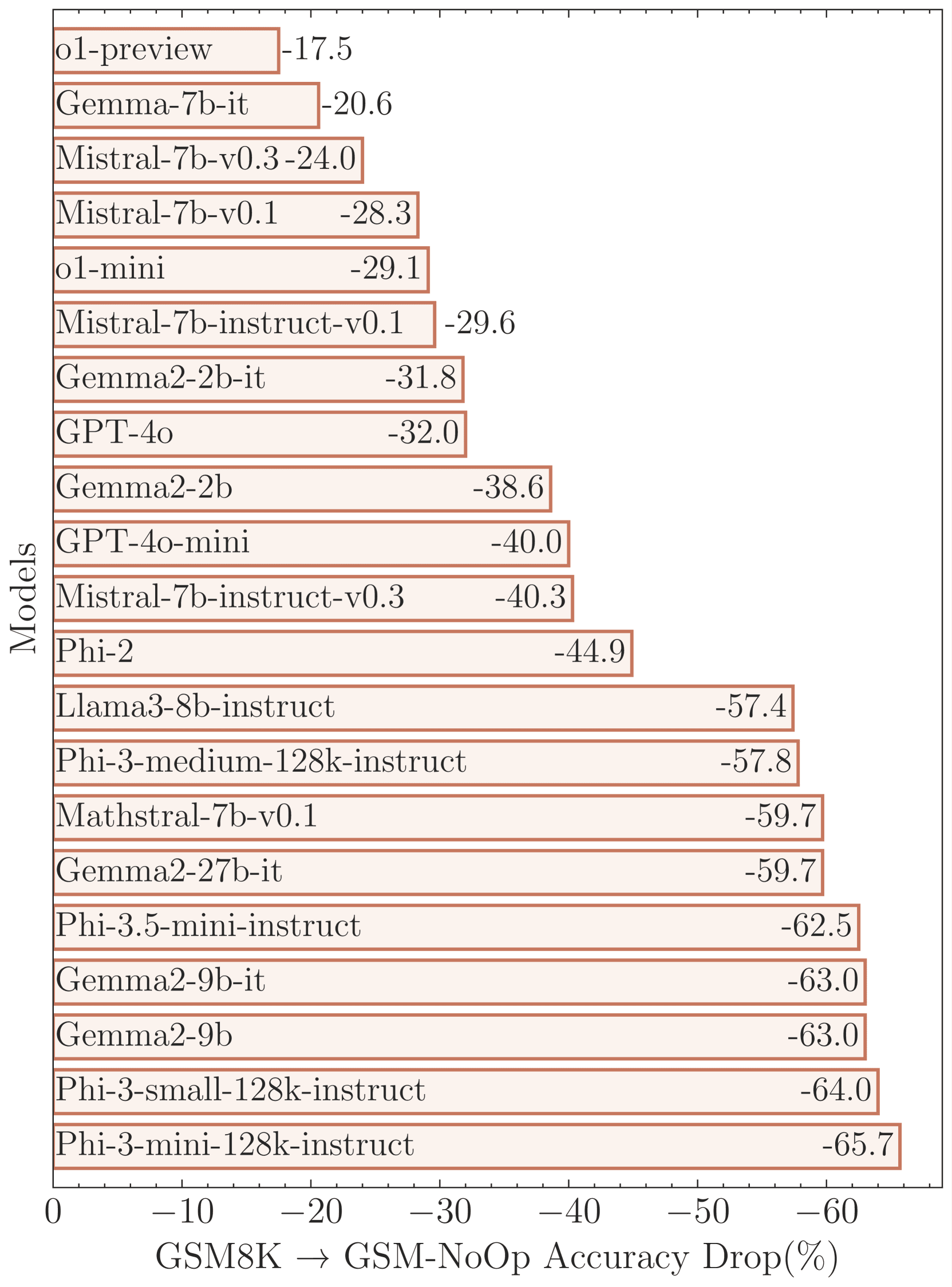
Figure (b) The performance of models drops significantly on GSM-NoOp, with more recent models experiencing a greater decline than older ones.
Here’s a crucial takeaway: LLMs don’t “reason”—but neither do we. What we call "reasoning" is an abstraction. The human brain, just like LLMs, often relies on intuition, pattern recognition, and probabilistic thinking. Complex, multi-step reasoning? Even humans lean on a mix of logic and gut feeling, just like LLMs.
Some experts argue that humans do engage in formal reasoning when required—like in single-step logic problems. But, as tasks become more complex, both humans and machines shift from strict logic to more heuristic methods. So, LLMs are closer to humans than we may think in this regard.
🔍 Reassessing Capabilities
The performance variability suggests we need to rethink how we evaluate mathematical reasoning in LLMs.
💡 Need for New Approaches
Instead of pattern recognition, we need systems that handle real logical reasoning.
🛠️ Improved Benchmark Design
GSM-Symbolic shows that nuanced, tougher benchmarks are crucial to pushing LLMs toward real problem-solving.
⚖️ Ethical Considerations
As LLMs increasingly serve real-world purposes, understanding these limitations is key to responsible use.
The GSM-Symbolic study underscores that current LLMs, much like humans when pushed beyond basic logic, struggle with genuine mathematical reasoning. The inconsistencies, sensitivity to changes, and difficulty in filtering out irrelevant information reveal fundamental gaps that can’t be addressed through better training alone. Future AI systems will need a paradigm shift in how they approach logic and complex problem-solving. As AI progresses, acknowledging these limits and designing better models will be crucial. Ultimately, the line between human and machine reasoning may be thinner than we think, but overcoming these challenges is key to building more reliable, intelligent systems.